
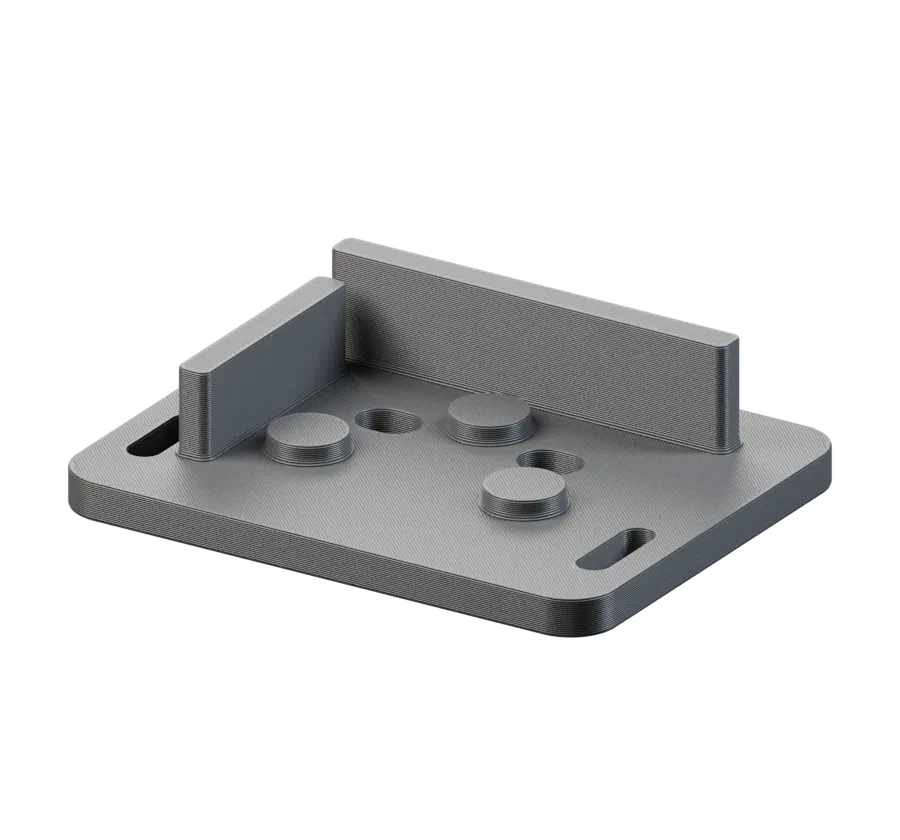

PET-CF17 Fiberon™ render of Ribbed three-pad inspection pallet, showing material texture and component geometry.

PET-CF17

Make stiff fixture bases, locating tools and equipment brackets in Polymaker Fiberon PET-CF17. We combine in-house FDM printing with practical help on orientation, heat treatment and the fit of your component.

✓
Stiff production fixtures
✓
17% carbon-fibre reinforcement
✓
Low moisture sensitivity
✓
Heat-treatment planning included
Technology

FDM

Post-processing
Tapping (internal threads)
Heat-set threaded inserts
Support removal
Colours

Polymaker

Material overview

Fiberon PET-CF17 is a PET grade reinforced with 17% carbon fibre. It is a strong candidate for rigid tooling, locating bases and equipment components where stiffness and dimensional stability matter.

Why choose PET-CF17?

Its low moisture sensitivity is useful when comparing reinforced polymers for repeatable workshop use. The higher published thermal performance follows annealing, so we plan the heat treatment and final fit together rather than treating the data as an automatic property of any print.

Typical applications

Fixture bases

Support and locate a workpiece in an assembly or inspection workflow.

Rigid brackets

Combine mounting points and reinforcing features around the installation.

Equipment guides

Create custom locating surfaces and interfaces for repeated use.

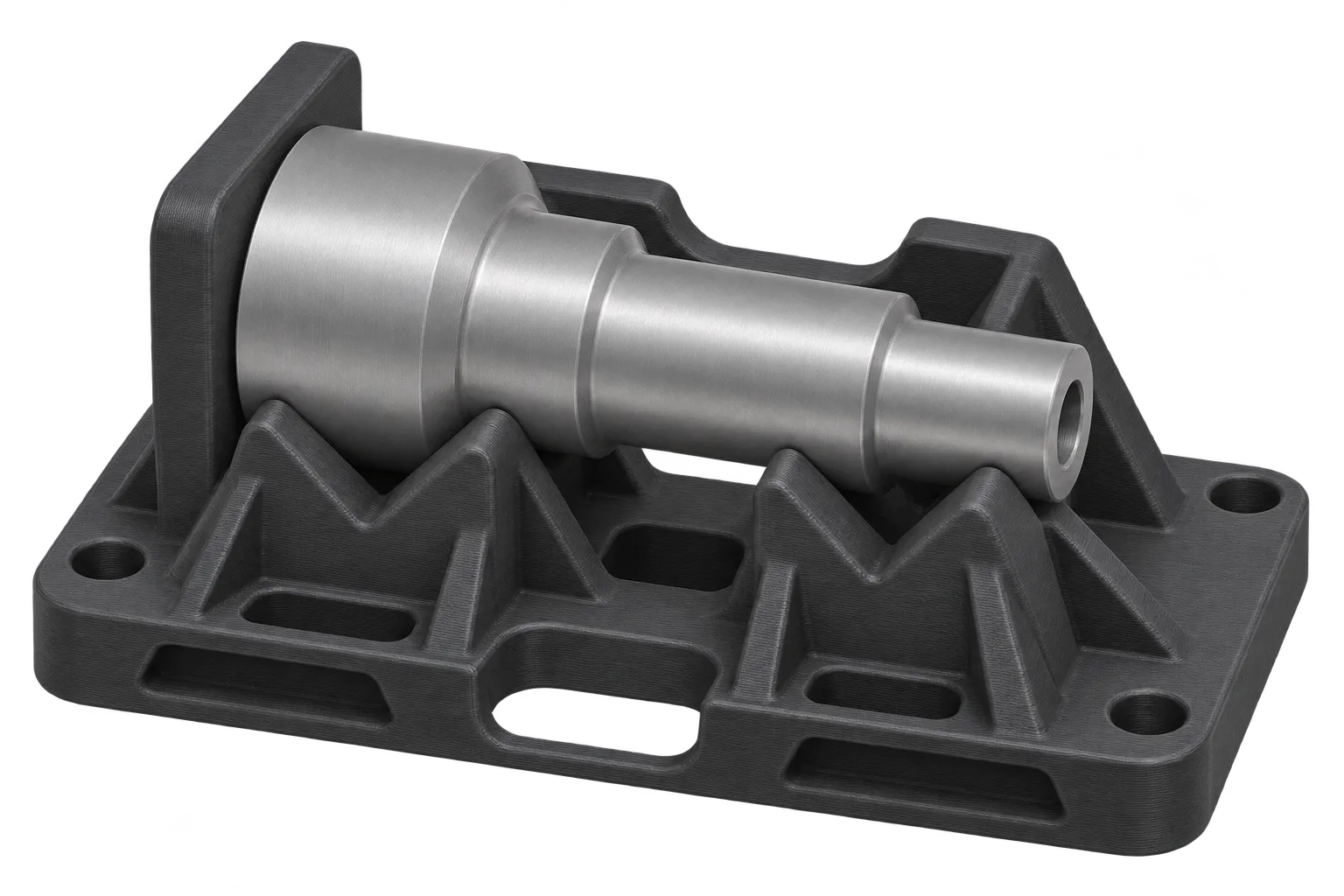
Charcoal fibre-reinforced polymer locating fixture supporting a stepped metal workpiece in shaped seats, with an end stop and open mounting holes.

Keep the fixture reference after heat treatment.

A locating nest only helps if its contact seats and end stop remain in the right positions. The illustrated fixture shows those reference features; PET-CF17 offers a stiff, low-moisture-sensitivity option for workshop tooling.

Best suited to

Rigid locating bases, inspection nests and repeat workshop components.

What to consider

The higher published thermal performance follows annealing. Plan final dimensional checks after the agreed treatment.

Make the first sample useful

Name the datum surfaces and the gap that accepts the workpiece. Keep removal and tool access clear, then check a first fixture against the actual component.

Material stiffness starts with a sensible structure.

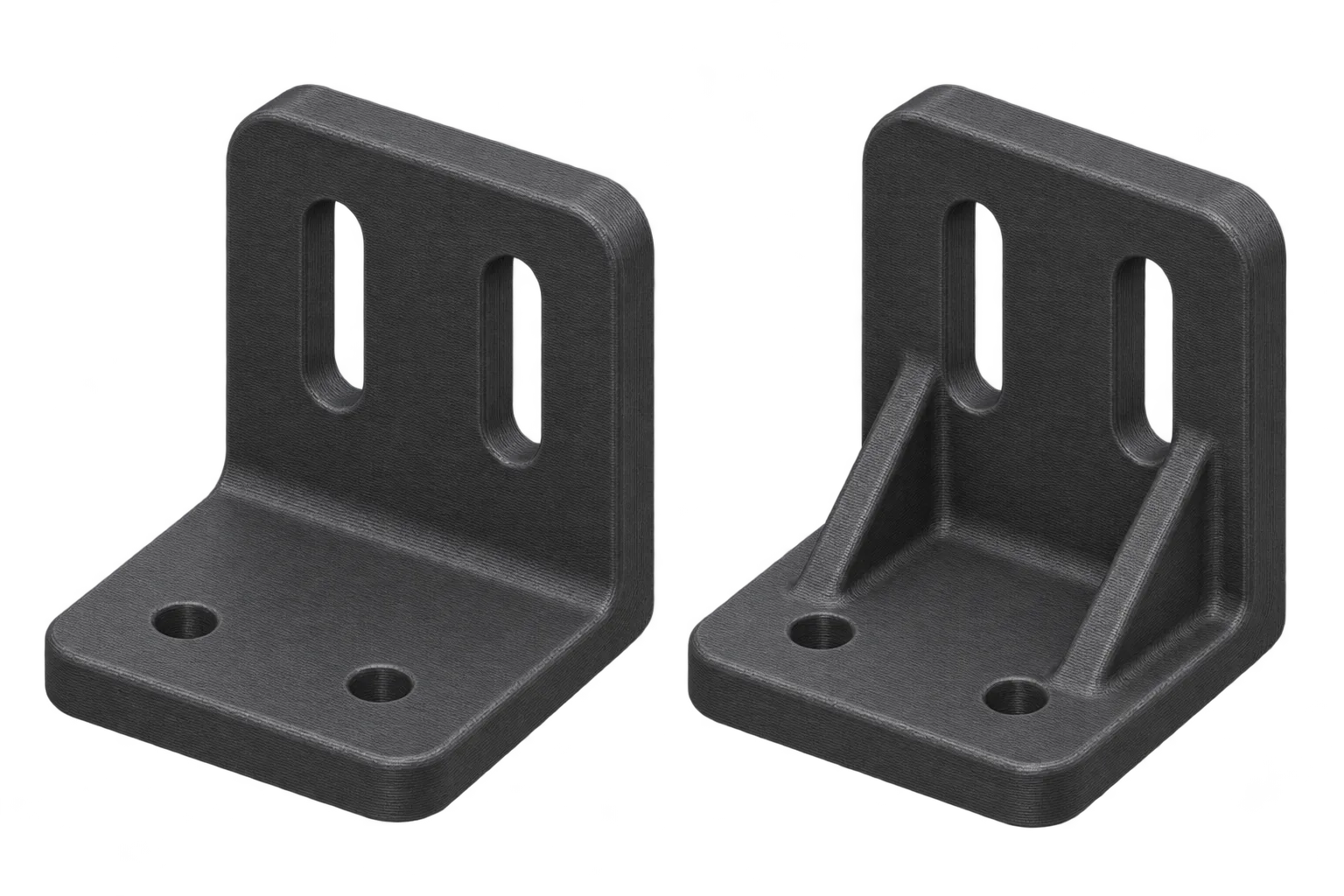
The bracket comparison shows how supporting ribs change the way a corner carries load. Fibre reinforcement helps the material resist deformation, but it does not replace a well-supported shape.

Match the build to the load

We plan print orientation around the forces at the mounting points. Strength across layers differs from strength along the printed paths.

Protect contact and fixing areas

Leave useful material around holes and spread clamping pressure where needed. A fibre-filled surface may mark a delicate workpiece; a replaceable contact pad can help.

Plan heat treatment and fit together

If annealing is part of the agreed process, we consider its effect on dimensions before final fit checks. The first fixture establishes the reference for repeat orders.

Explore the Printing Guide →

Two charcoal FDM brackets showing an unreinforced corner and the same bracket with supporting ribs and accessible mounting holes.

Order your Fiberon PET-CF17 part.

Send the design and quantity

Provide the workpiece dimensions and operating temperature. State which fits must be accepted after annealing rather than relying on the as-printed dimensions. No usable CAD yet? Send a drawing or photo to discuss the next step.

Compare price and plan delivery

Price depends on the size and geometry, quantity and selected finishing. Compare the available options online and tell us when you need the parts. We review custom requirements with you and confirm timing once the production brief is clear.

Agree the finish and fit

Available options include tapped internal threads, heat-set threaded inserts, where the design allows. Printed parts retain a layer pattern. We plan important fits and visible surfaces around the build, and discuss further finishing where needed. Choose from the colours shown for this material when quoting.

Start with one part or a batch. We make the components in-house using FDM and retain the agreed production details for repeat orders.

Upload CAD & get a quote →   Discuss your part →

Technical properties

Manufacturer test data helps compare grades. Printed-part performance also depends on the design and print direction. Our team can help interpret the values for your application.

Source: Fiberon PET-CF17 manufacturer technical data. Polymaker’s PET-CF17 results use specimens annealed at 120°C for 10 hours. UL 94 HB at 1.5 mm is a horizontal-burning classification, not evidence of V-0 performance. Heat-deflection temperature is a test under a stated load, not a continuous service-temperature rating. We help interpret the values for your component.

Tensile strength

X–Y: 65.9 ± 1.0 MPa; Z: 27.9 ± 1.3 MPa (ISO 527, GB/T 1040; specimens annealed at 120°C for 10 h)

Tensile modulus

X–Y: 5481.0 ± 223.7 MPa; Z: 3558.8 ± 260.4 MPa (ISO 527, GB/T 1040; specimens annealed at 120°C for 10 h)

Elongation at break

X–Y: 2.4 ± 0.5%; Z: 0.8 ± 0.1% (ISO 527, GB/T 1040; specimens annealed at 120°C for 10 h)

Heat deflection temperature

147.5°C at 0.45 MPa (ISO 75; specimens annealed at 120°C for 10 h)

Material performance and test data

  • Flammability test: UL 94 HB at 1.5 mm (not a flame-retardant classification).

Compare PET-CF17 with other materials.

Compare PA12-CF10 for a reinforced nylon option, PPA-CF for demanding tooling and PPS-CF10 where heat and chemical exposure drive selection.

PA12-CF10

Compare reinforced nylon with its own toughness and moisture behaviour.

PPA-CF

For another stiff reinforced polymer aimed at demanding tooling.

PPS-CF10

For a PPS option when chemical and thermal conditions are more demanding.

Fiberon PET-CF17 3D printing questions.

Does PET-CF17 need annealing?

The published mechanical and thermal results shown here use specimens annealed at 120°C for 10 hours. We agree whether heat treatment is needed and plan dimensional checks around the selected condition.

Is PET-CF17 flame retardant?

The TDS reports UL 94 HB at 1.5 mm. That is not the same as a V-0 flame-retardant classification. If fire behaviour is specified, we can compare a documented flame-retardant grade.

Can the printed fixture touch a delicate finished surface?

A fibre-filled printed surface can mark or wear a sensitive workpiece. We can discuss a replaceable contact pad or a different material at the contact area.

Upload your CAD and get a quote, or talk to our team about the application.