
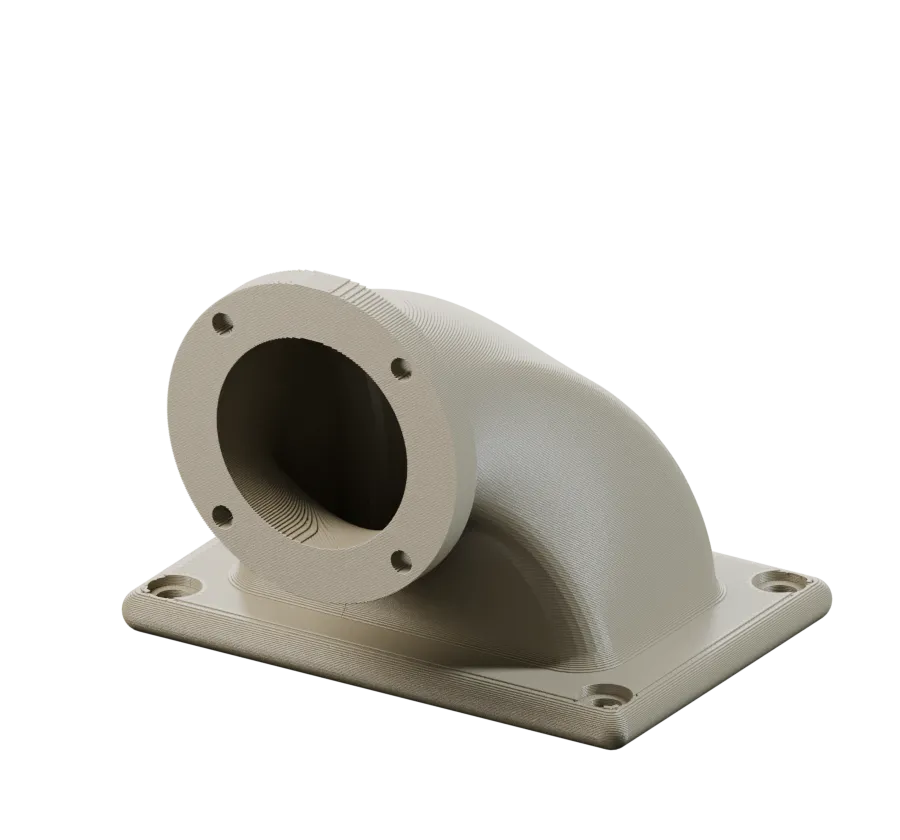
PEI 9085 Ultem material render of Curved transition duct, showing the printed surface and component geometry.

PEI 9085

Make custom ducts, housings and technical components in 3D4MAKERS PEI 9085. We combine high-temperature FDM production with material guidance for projects where heat and fire performance matter.

✓
Flame-retardant PEI grade
✓
Custom ducts and housings
✓
Documented heat-release results
✓
Support for demanding applications
Technology

FDM

Post-processing
Textured surface (fuzzy skin)
Heat-set threaded inserts
Support removal
Colours

3D4MAKERS

Material overview

PEI 9085 is a flame-retardant PEI grade used for rigid technical components where heat and fire behaviour are important together. With high-temperature FDM, its material capabilities can be applied to custom ducts, housings and equipment interfaces.

Why choose PEI 9085?

We help turn the application into a practical design and production plan. For transport or other specified uses, the material documentation is reviewed alongside the installation requirements. That keeps the useful geometry, manufacturing approach and required component checks connected.

Typical applications

Air ducts and transitions

Route air around equipment with a custom passage and mounting flange.

Technical housings

Create a rigid shell around interfaces and internal components.

Transport project components

Explore custom parts where the project specifies fire or heat-release requirements.

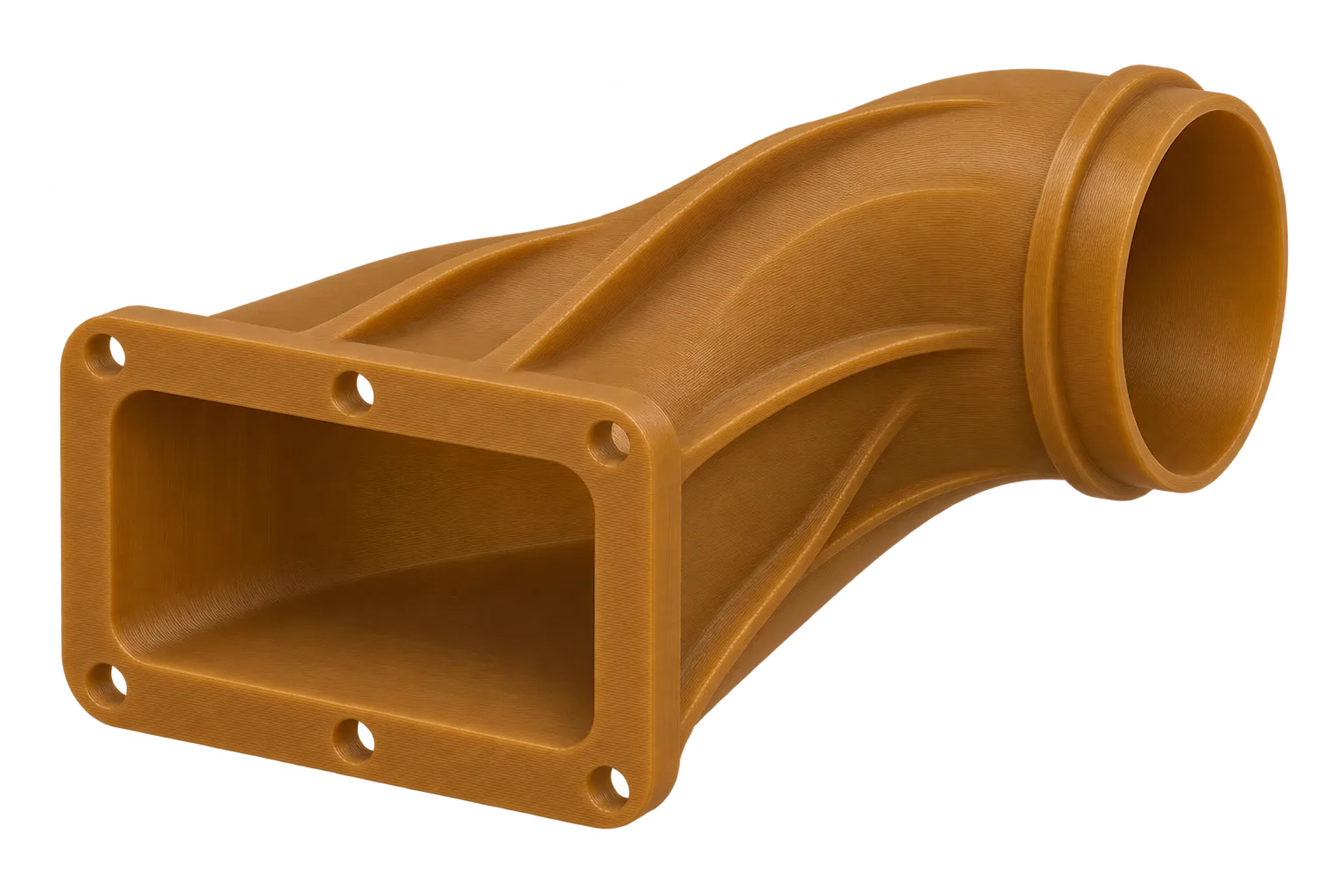
Amber PEI rectangular-to-round transition duct with an open passage, reinforcing ribs, mounting flange and beaded outlet.

Route the duct and plan its evidence.

The illustrated transition shows how a custom duct can follow the equipment layout while keeping a usable flange and round outlet. PEI 9085 is worth considering where heat and specified fire behaviour matter together.

Best suited to

Rigid transport or equipment ducts and housings with a defined heat and fire-performance brief.

What to consider

Match the actual test scope to the project. Raw-material references and printed-specimen results are different evidence.

Make the first sample useful

Show the duct location, mounting loads and required connections. Agree the first-part fit check and any separate component qualification.

A complex duct should still be practical to produce.

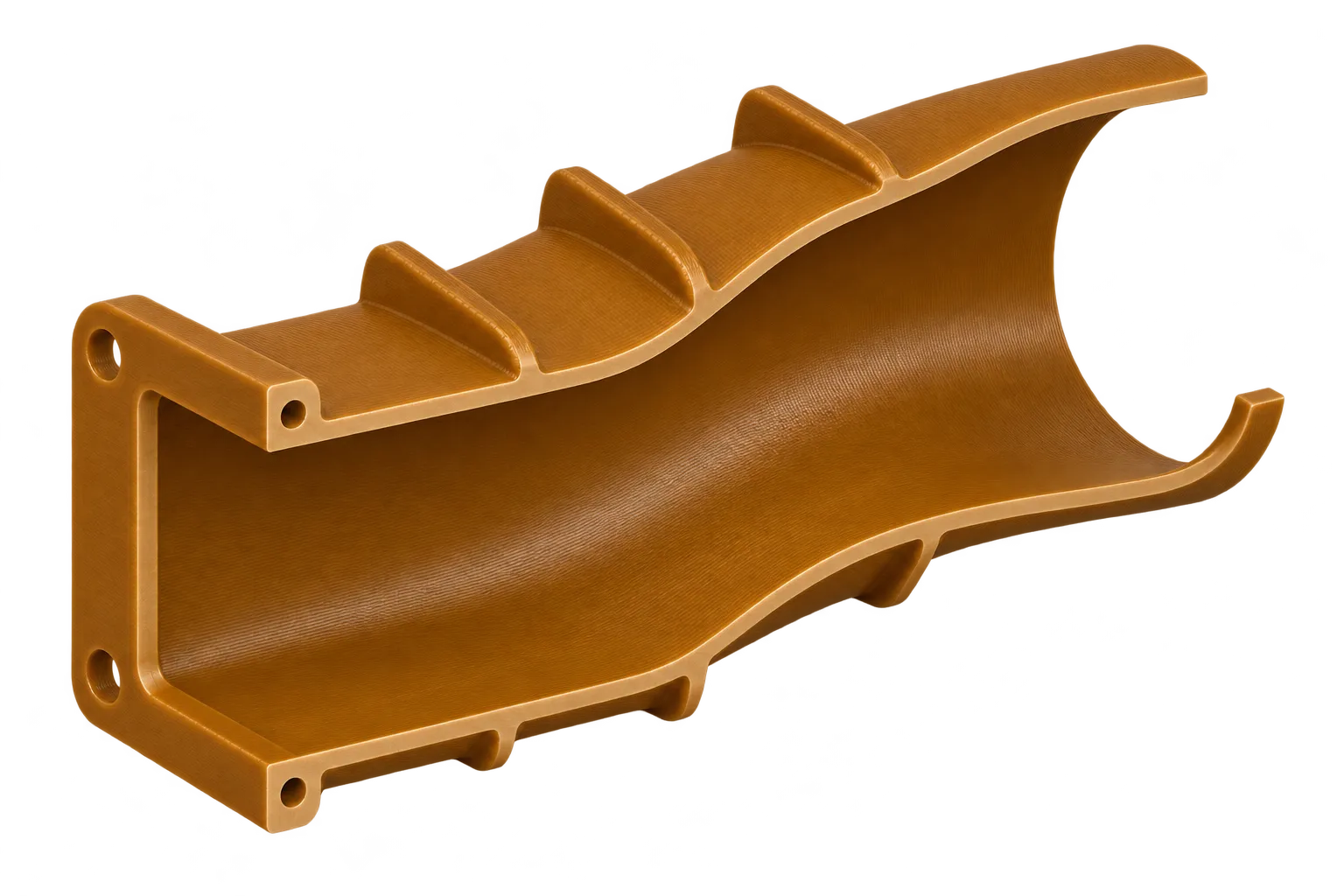
The longitudinal cutaway reveals an open passage through the transition. Wall structure, print direction and support access are planned together so the useful interior is not lost behind an attractive outer shape.

Keep internal access

We review where supports may be needed and how they can be removed. Some enclosed geometries are better split and joined.

Support the flange and outlet

Ribs and rounded transitions help transfer mounting loads into the body. We also consider clamping pressure at a hose connection.

Plan the working fit

Heat, sustained loads and the printed surface all affect fit. Sealing or pressure-tightness requires a suitable joint and an agreed check; the illustration does not imply a pressure rating.

Explore the Printing Guide →

Longitudinal half-section of an amber PEI transition duct showing a continuous open passage, wall thickness and external ribs.

Order your 3D4MAKERS PEI 9085 part.

Send the design and quantity

Include the installation drawing and the required standard or customer specification. Identify minimum wall sections, operating temperatures and connection loads. No usable CAD yet? Send a drawing or photo to discuss the next step.

Compare price and plan delivery

Price depends on the size and geometry, quantity and selected finishing. Compare the available options online and tell us when you need the parts. We review custom requirements with you and confirm timing once the production brief is clear.

Agree the finish and fit

Available options include textured walls (fuzzy skin), heat-set threaded inserts, where the design allows. Printed parts retain a layer pattern. We plan important fits and visible surfaces around the build, and discuss further finishing where needed. Choose from the colours shown for this material when quoting.

Start with one part or a batch. We make the components in-house using FDM and retain the agreed production details for repeat orders.

Upload CAD & get a quote →   Discuss your part →

Technical properties

Manufacturer test data helps compare grades. Printed-part performance also depends on the design and print direction. Our team can help interpret the values for your application.

Source: 3D4MAKERS PEI 9085 manufacturer technical data. The 3D4MAKERS PEI 9085 TDS reports FAR 25.853 heat-release and vertical-burn results. UL 94 ratings are stated without specimen thickness in that sheet. Material results do not establish finished-part or installation approval. Heat-deflection temperature is a test under a stated load, not a continuous service-temperature rating. We help interpret the values for your component.

Tensile strength

84 MPa at yield; 74 MPa at break, 5 mm/min — TDS lists ASTM D738

Tensile modulus

3440 MPa, 5 mm/min — TDS lists ASTM D738

Elongation at break

72% at break, 5 mm/min — TDS lists ASTM D738

Heat deflection temperature

152°C at 1.8 MPa — ISO 75/Af; flatwise 80 × 10 × 4 mm, 64 mm span

Density

1.34 g/cm³ — ISO 1183; material density

Material performance and test data

  • Flame ratings: UL 94 V-0 and 5VA stated in the TDS; thickness is not specified.
  • Heat release: FAR 25.853, OSU total 16 kW·min/m² (2-minute test); peak 36 kW/m² (5-minute test).
  • Vertical burn: FAR 25.853, TDS reports a pass at 60 seconds and 2-second result.
  • Limiting oxygen index: 49%, ASTM D2863.

Compare PEI 9085 with other materials.

Compare PEI 1010 using its own thermal and electrical data. PC/ABS FR or PC-FR V0 may be relevant when their properties and documented test scope fit the installation.

PEI 1010

Compare another PEI grade for rigid heat-resistant technical parts.

PC/ABS FR

For technical housings with a different thermal range and fire-test scope.

PEEK

For projects led by demanding chemical and mechanical exposure.

3D4MAKERS PEI 9085 3D printing questions.

Does PEI 9085 make an aircraft-approved part?

No. The material’s reported test results support selection, but approval of an aircraft component depends on the installation, design, manufacturing route and required tests. We help define the material side of that process.

How does PEI 9085 compare with PEI 1010?

They are different PEI grades. Compare the required heat, mechanical response and relevant fire tests; PEI 1010 is not simply an upgraded version of 9085.

Can you print enclosed ducts in PEI 9085?

We review the passage and support access first. Some shapes can be printed as one part; others are more practical as joined sections. Sealing and any pressure requirement are agreed separately.

Upload your CAD and get a quote, or talk to our team about the application.