
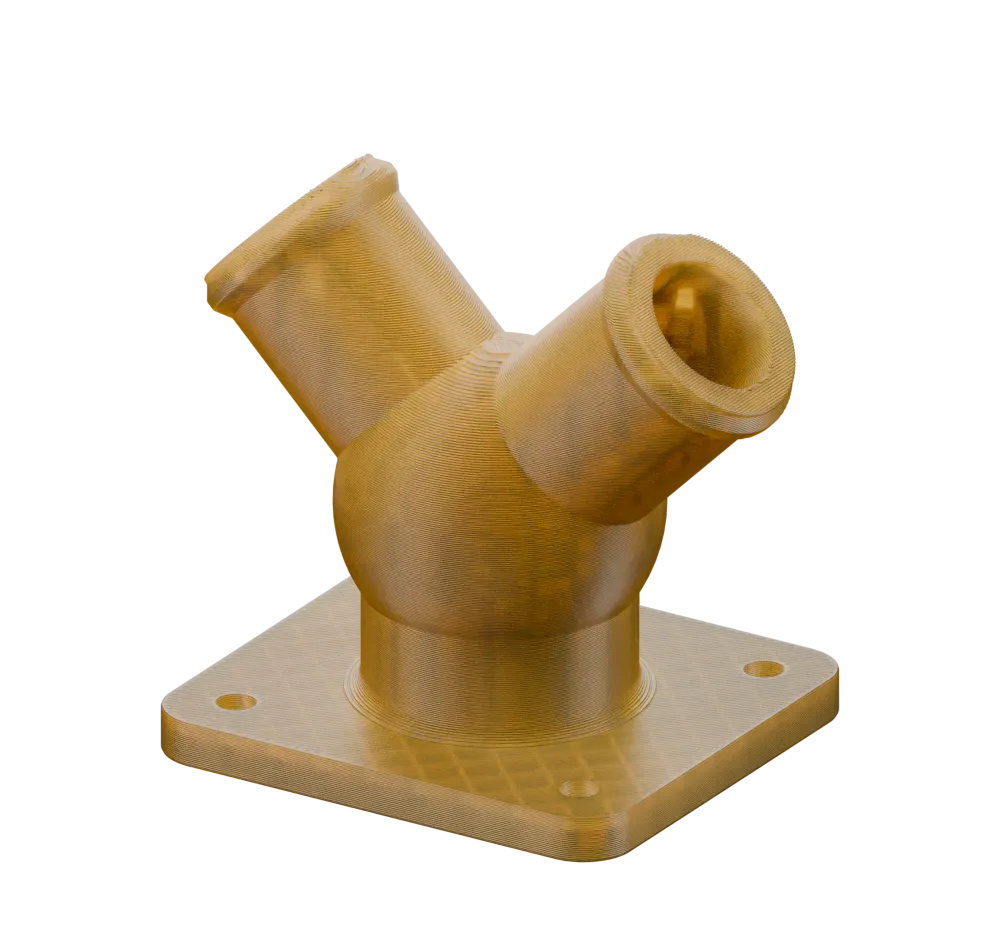
PEI 1010 Ultem material render of Twin hose Y duct · integrated outlets, showing the printed surface and component geometry.

PEI 1010

Print rigid ducts, technical housings and equipment interfaces in 3D4MAKERS PEI 1010. Our high-temperature FDM service helps turn this specialist polymer into a practical component for demanding applications.

✓
Rigid heat-resistant components
✓
Custom ducts and housings
✓
Electrical-insulation properties
✓
Specialist in-house FDM support
Technology

FDM

Post-processing
Textured surface (fuzzy skin)
Heat-set threaded inserts
Support removal
Colours

3D4MAKERS

Material overview

PEI 1010 is an unfilled polyetherimide for rigid technical components where heat resistance, stiffness and electrical properties are useful together. The 3D4MAKERS filament gives access to custom geometry through high-temperature FDM.

Why choose PEI 1010?

Typical projects include shaped ducts, equipment carriers and technical housings. We help choose between PEI grades, plan the build and review any flame or electrical requirements. Its characteristic amber appearance and printed texture are part of the material’s visual character.

Typical applications

Custom ducts

Connect equipment openings with a shaped passage and integral mounting features.

Technical housings

Arrange interfaces and supports around heat-exposed equipment.

Electrical equipment carriers

Position components where the grade’s insulating properties are relevant to the design.

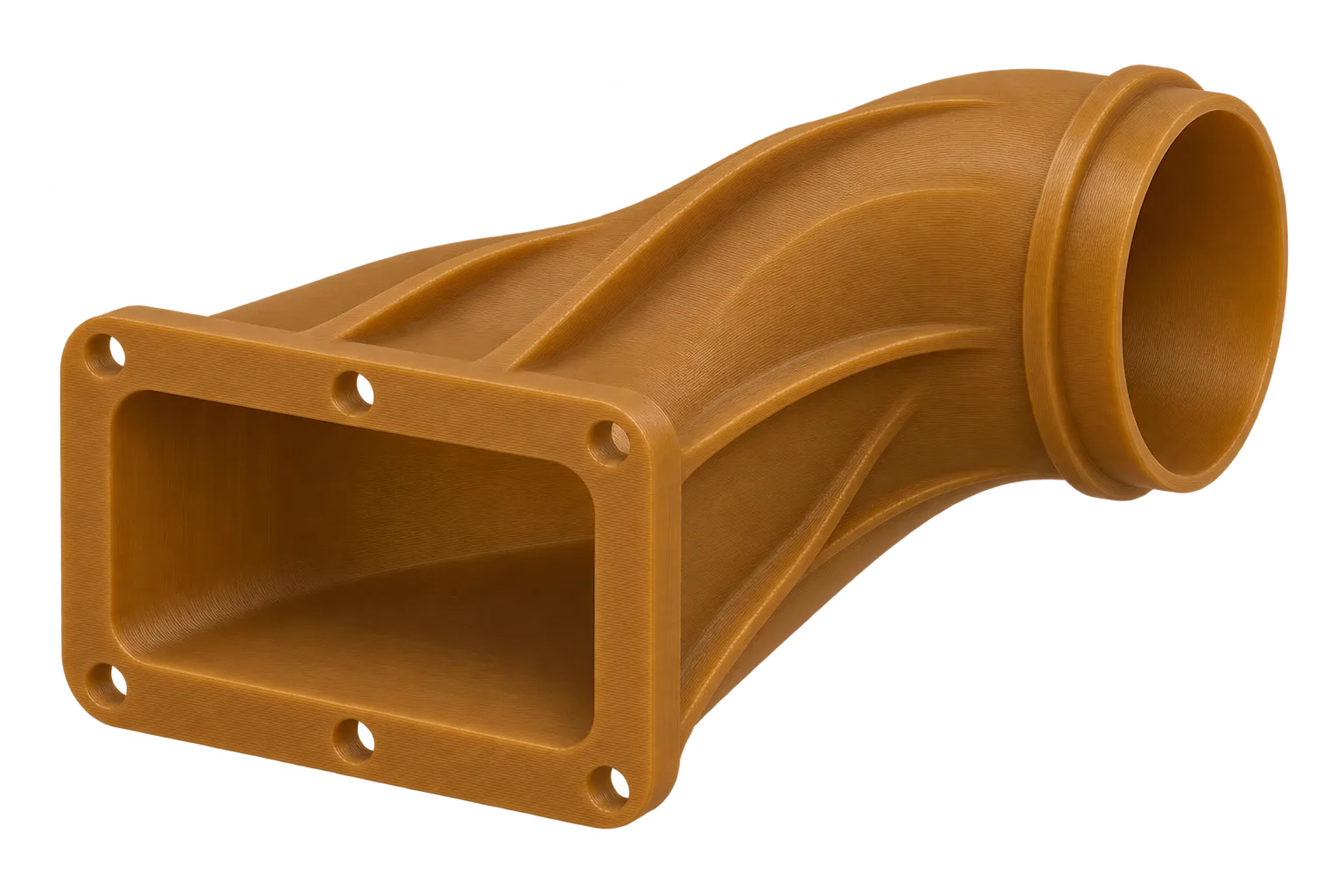
Amber PEI rectangular-to-round transition duct with an open passage, reinforcing ribs, mounting flange and beaded outlet.

Connect the duct to the available space.

The illustrated transition joins a rectangular opening to a round connection. PEI 1010 is a specialist option when that custom shape also needs a rigid structure and demanding heat performance.

Best suited to

Rigid ducts, technical housings and carriers where thermal or electrical properties guide selection.

What to consider

The installation load, temperature and exact evidence matter. A material test result is not approval of the finished duct or assembly.

Make the first sample useful

Locate both interfaces and leave room for flange screws and hose retention. Check the first part with the surrounding equipment.

A complex duct should still be practical to produce.

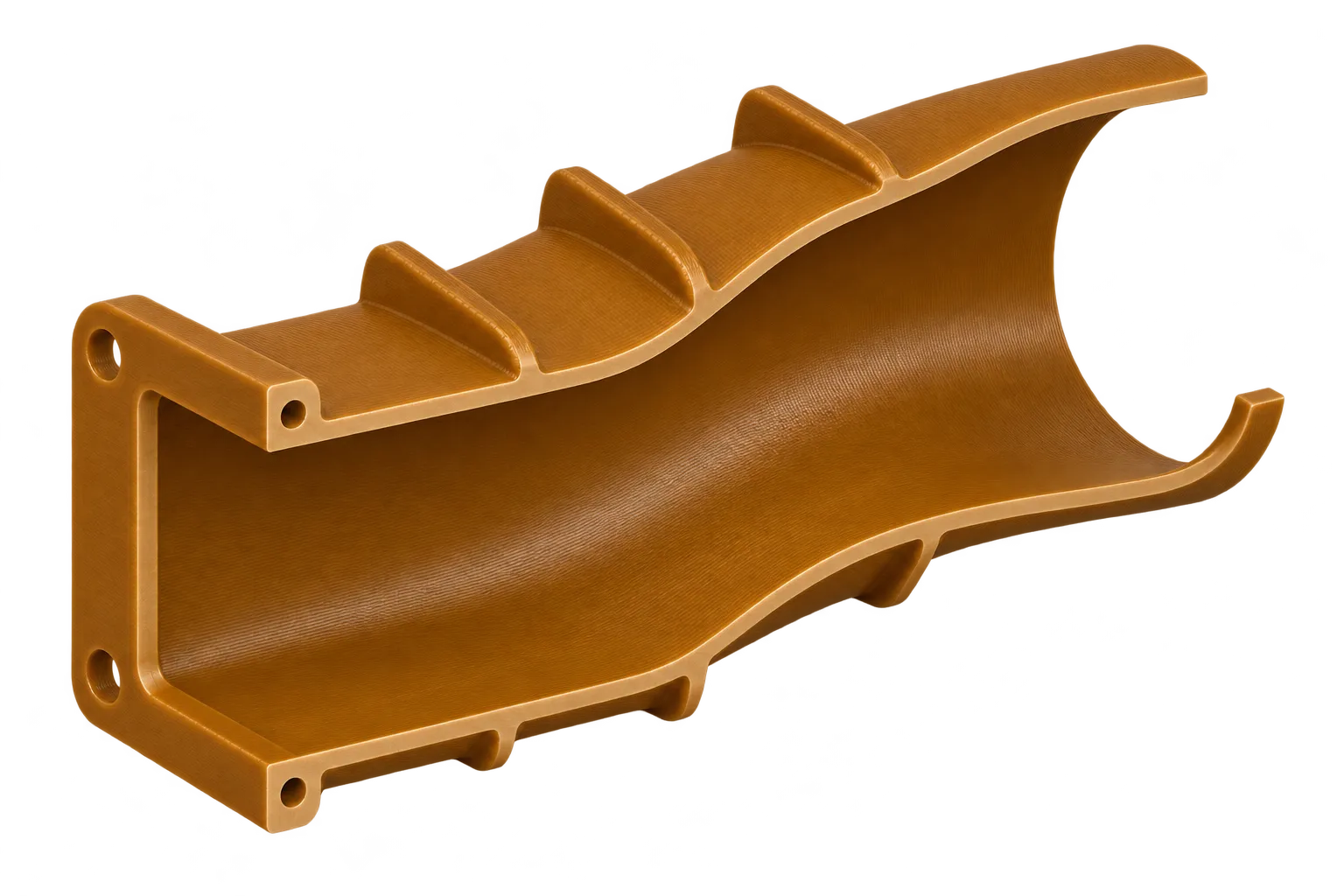
The longitudinal cutaway reveals an open passage through the transition. Wall structure, print direction and support access are planned together so the useful interior is not lost behind an attractive outer shape.

Keep internal access

We review where supports may be needed and how they can be removed. Some enclosed geometries are better split and joined.

Support the flange and outlet

Ribs and rounded transitions help transfer mounting loads into the body. We also consider clamping pressure at a hose connection.

Plan the working fit

Heat, sustained loads and the printed surface all affect fit. Sealing or pressure-tightness requires a suitable joint and an agreed check; the illustration does not imply a pressure rating.

Explore the Printing Guide →

Longitudinal half-section of an amber PEI transition duct showing a continuous open passage, wall thickness and external ribs.

Order your 3D4MAKERS PEI 1010 part.

Send the design and quantity

Send both mating interfaces, the available space and the temperature profile. Add any electrical or fire requirement and identify the flange faces that must fit. No usable CAD yet? Send a drawing or photo to discuss the next step.

Compare price and plan delivery

Price depends on the size and geometry, quantity and selected finishing. Compare the available options online and tell us when you need the parts. We review custom requirements with you and confirm timing once the production brief is clear.

Agree the finish and fit

Available options include textured walls (fuzzy skin), heat-set threaded inserts, where the design allows. Printed parts retain a layer pattern. We plan important fits and visible surfaces around the build, and discuss further finishing where needed. Choose from the colours shown for this material when quoting.

Start with one part or a batch. We make the components in-house using FDM and retain the agreed production details for repeat orders.

Upload CAD & get a quote →   Discuss your part →

Technical properties

Manufacturer test data helps compare grades. Printed-part performance also depends on the design and print direction. Our team can help interpret the values for your application.

Source: 3D4MAKERS PEI 1010 manufacturer technical data. The linked 3D4MAKERS PEI 1010 sheet provides material reference data, including UL 94 V-0 at 1.5 mm and 5VA at 3.0 mm. These are not directional printed-part design allowables. Relative thermal index and heat-deflection results describe different tests. Heat-deflection temperature is a test under a stated load, not a continuous service-temperature rating. We help interpret the values for your component.

Tensile strength

105 MPa at yield; 85 MPa at break — ISO 527-2/50

Tensile modulus

3200 MPa — TDS lists ISO 572-2/1

Elongation at break

60% at break — ISO 527-2/50

Heat deflection temperature

190°C at 1.8 MPa, ISO 75-2/Ae; 200°C at 0.45 MPa, ISO 75-2/Be — unannealed, 100 mm span

Density

1.27 g/cm³ — ISO 1183; material density

Material performance and test data

  • Flame rating: UL 94 V-0 at 1.5 mm; 5VA at 3.0 mm.
  • Glow-wire flammability index: 960°C at 3.2 mm, IEC 60695-2-12.
  • Relative thermal index: 170°C for electrical, impact and strength, UL 746.
  • Ball-pressure test: pass at 125°C, IEC 60695-10-2.

Compare PEI 1010 with other materials.

Compare PEI 9085 when its fire and heat-release evidence matches the brief. Consider PEEK for different chemical/mechanical conditions or PPS-GF20 for a reinforced carrier.

PEI 9085

Compare a different PEI formulation with fire and heat-release results.

PEEK

For another specialist polymer when chemical and mechanical conditions lead the choice.

PPS-GF20

For a reinforced PPS option with stiffness and electrical-insulation data.

3D4MAKERS PEI 1010 3D printing questions.

Is PEI 1010 the same as PEI 9085?

No. They are different grades with different formulations, mechanical behaviour and test data. We compare the application and relevant evidence rather than treating the numbers as a simple quality ranking.

Can PEI 1010 be used in electrical equipment?

It is a material to consider because of its electrical-insulation and thermal data. The component geometry, operating conditions and required electrical approvals still guide the finished design.

What does the flame rating mean for my part?

The linked TDS reports UL 94 V-0 at 1.5 mm and 5VA at 3.0 mm. We help review the relevant material condition and the component requirements; a grade rating is not a blanket approval of any printed part.

Upload your CAD and get a quote, or talk to our team about the application.