
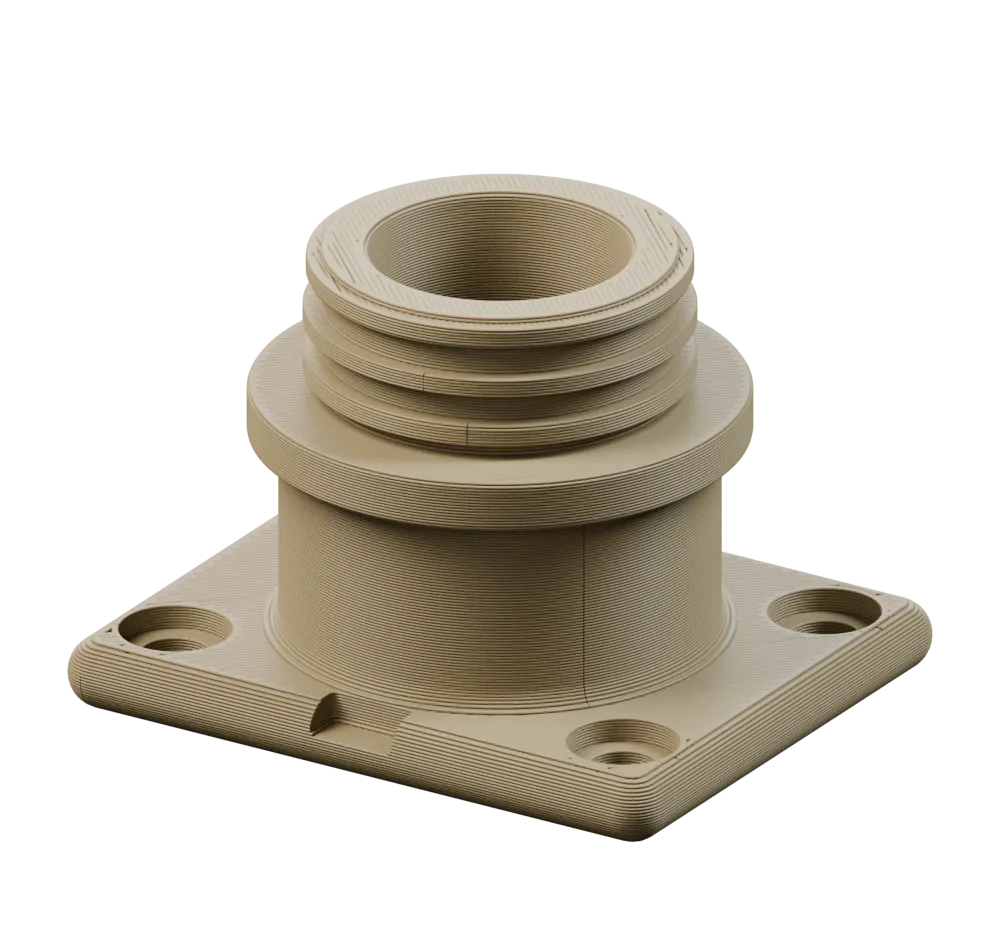
PEEK 3D4MAKERS material render of Flanged flow adapter, showing the printed surface and component geometry.

PEEK

Print specialist fixtures, guide carriers and equipment components in 3D4MAKERS PEEK. Our high-temperature FDM team helps plan the material, thermal process and final fit around demanding heat, chemicals and loads.

✓
Specialist engineering polymer
✓
Heat and chemical resistance
✓
Custom tooling and interfaces
✓
Thermal-process and fit guidance
Technology

FDM

Post-processing
Tapping (internal threads)
Heat-set threaded inserts
Support removal
Colours

3D4MAKERS

Material overview

PEEK is a high-performance semi-crystalline polymer to consider when heat, chemical contact and mechanical demands exceed the role of everyday printing materials. It can be used for custom equipment interfaces, guide carriers and process tooling.

Why choose PEEK?

The result depends on more than choosing PEEK in a menu. We plan the build, material condition and any heat treatment around the geometry and service environment. That preparation helps turn a specialist polymer into a component that can be fitted, checked and reproduced.

Typical applications

Process tooling

Create fixtures and guides for a demanding manufacturing environment.

Equipment interfaces

Combine bores, mounting feet and connection features in a custom part.

Chemical-exposed components

Explore the grade against the actual substance, concentration, temperature and load.

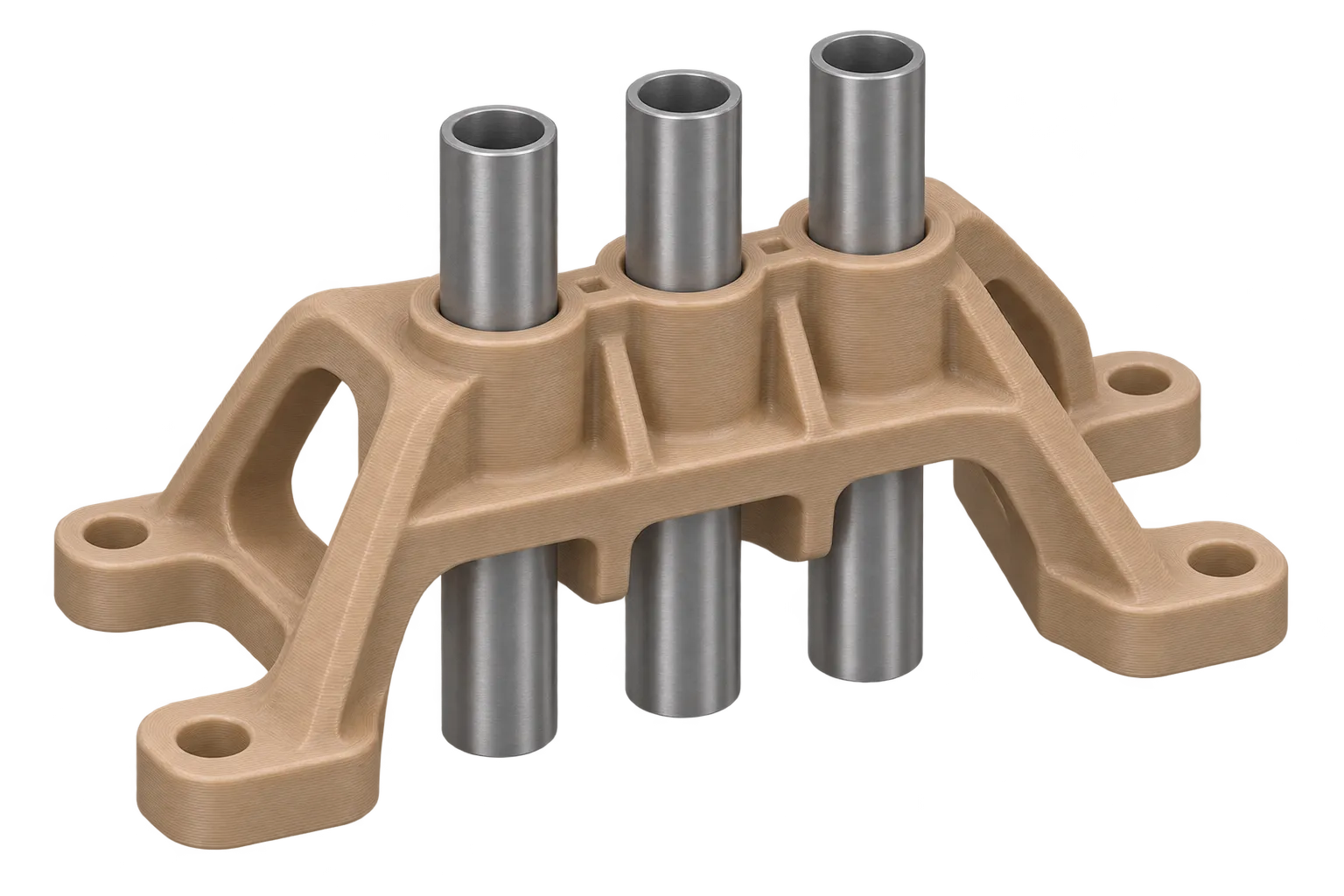
Tan PEEK guide carrier with three metal probe tubes passing through individual bores, filleted ribs and accessible mounting feet.

Choose the polymer around the process.

The illustrated guide carrier combines bores, a ribbed bridge and mounting feet. Its shape can be made in several polymers; PEEK becomes relevant when the process environment is the reason for choosing a specialist material.

Best suited to

Equipment interfaces and guide carriers facing combined heat, chemical and mechanical demands.

What to consider

The material condition, build direction and any heat treatment affect the result. Specify the environment before treating PEEK as the default upgrade.

Make the first sample useful

Keep the tubes or moving hardware removable. Identify the guide fits and mounting faces that must be checked after the agreed process.

Plan the bore, the build and the final fit.

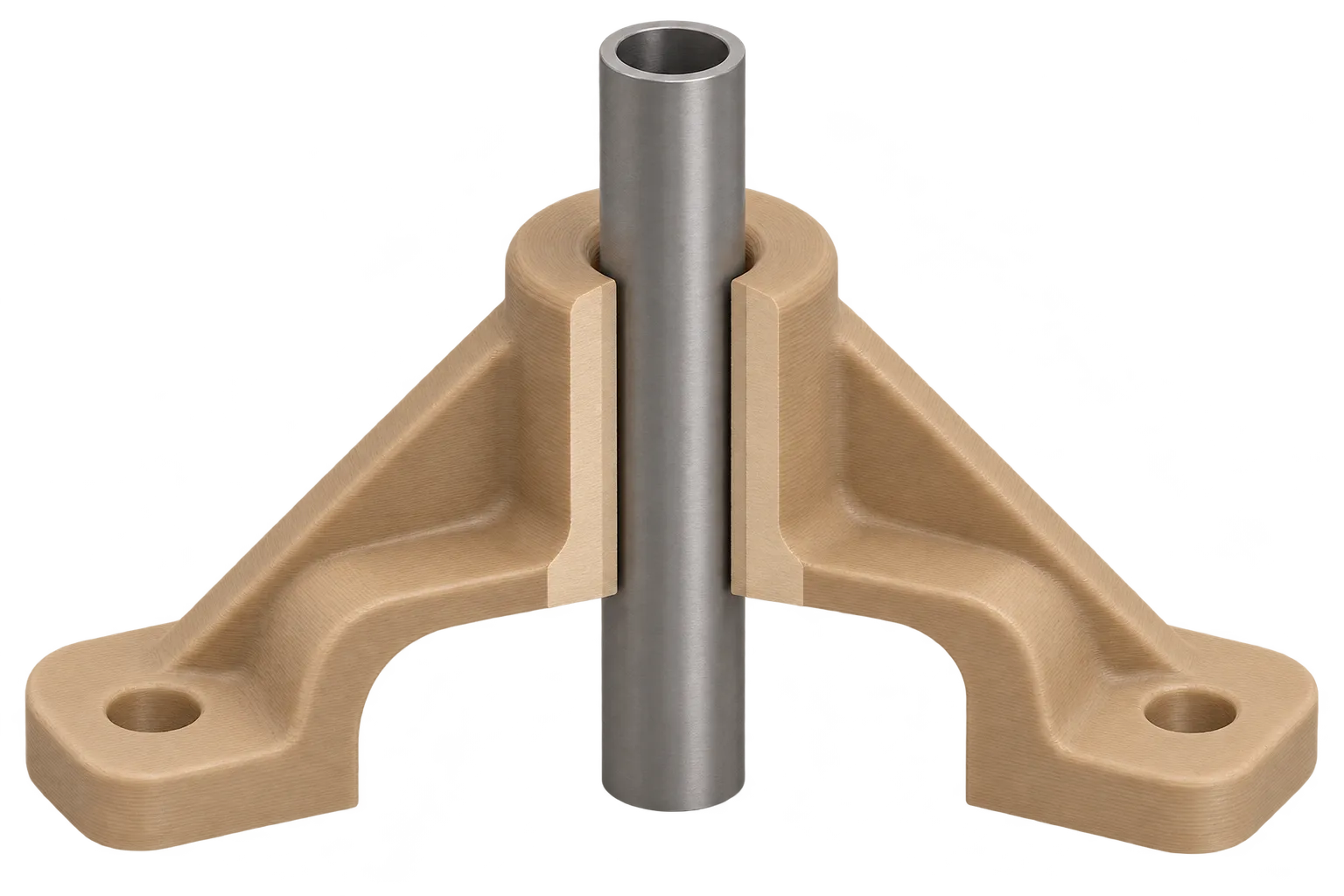
The section shows a tube passing through a supported guide bore. It illustrates a clearance fit, not a seal. PEEK can make demanding components, but a useful fit depends on the whole manufacturing plan.

Manage material condition

PEEK is semi-crystalline. We plan the thermal process and any annealing around the intended material condition and dimensional requirements.

Identify the important surfaces

Tell us which bores locate a part, which faces carry a load and where clearance is needed. We can discuss machining or inspection where appropriate.

Try the assembly in its working conditions

A first part allows fit and function to be checked before a batch. Hot, wet or chemically exposed service may behave differently from a room-temperature fit check.

Explore the Printing Guide →

Half-section of a tan PEEK guide support showing a metal tube passing through an open bore with clearance and ribbed mounting feet.

Order your 3D4MAKERS PEEK part.

Send the design and quantity

Send the mating hardware dimensions and describe temperature, chemicals and contact loads. Mark sliding fits and the required maintenance clearance. No usable CAD yet? Send a drawing or photo to discuss the next step.

Compare price and plan delivery

Price depends on the size and geometry, quantity and selected finishing. Compare the available options online and tell us when you need the parts. We review custom requirements with you and confirm timing once the production brief is clear.

Agree the finish and fit

Available options include tapped internal threads, heat-set threaded inserts, where the design allows. Printed parts retain a layer pattern. We plan important fits and visible surfaces around the build, and discuss further finishing where needed. Choose from the colours shown for this material when quoting.

Start with one part or a batch. We make the components in-house using FDM and retain the agreed production details for repeat orders.

Upload CAD & get a quote →   Discuss your part →

Technical properties

Manufacturer test data helps compare grades. Printed-part performance also depends on the design and print direction. Our team can help interpret the values for your application.

Source: 3D4MAKERS PEEK manufacturer technical data. The 3D4MAKERS PEEK sheet provides material reference values, including as-moulded thermal data. These should not be presented as guaranteed properties of an FDM print. Crystallinity, build direction and heat treatment affect the printed component. Heat-deflection temperature is a test under a stated load, not a continuous service-temperature rating. We help interpret the values for your component.

Tensile strength

105 MPa at yield, 23°C — ISO 527; material reference data

Tensile modulus

4100 MPa at 23°C — ISO 527; material reference data (4.1 GPa in source)

Elongation at break

30% at break, 23°C — ISO 527; material reference data

Heat deflection temperature

156°C at 1.8 MPa, as moulded — ISO 75A-f

Density

1.30 g/cm³, crystalline — ISO 1183; material density

Material performance and test data

  • Chemical resistance: reported by the manufacturer; confirm compatibility for the actual exposure.
  • Electrical relative thermal index: 260°C, UL 746B; material reference value.
  • Shore D hardness: 85 at 23°C, ISO 868.

Compare PEEK with other materials.

Compare PEI 1010 when its properties cover the working conditions. Reinforced PPS may be an alternative where stiffness and the exposure profile suit it.

PEI 1010

For rigid heat-resistant parts with a different polymer structure and evidence set.

PPS-CF10

For reinforced PPS tooling where stiffness, heat and chemistry are priorities.

PPS-GF20

For glass-reinforced PPS components with electrical-insulation data.

3D4MAKERS PEEK 3D printing questions.

Is PEEK always the best high-temperature choice?

No. The right choice depends on the load, temperature, chemicals, geometry and cost. PEI or reinforced PPS may meet the need with a different production approach. We compare the application before choosing.

Are all PEEK prints chemically resistant to everything?

No. Compatibility depends on the chemical, concentration, temperature and exposure time. Share the service conditions so we can review the exact grade and any testing needed.

Can this PEEK be used for medical or food-contact parts?

Do not infer suitability or approval from the polymer name. The exact grade, process, traceability and intended contact use must be established for that application.

Upload your CAD and get a quote, or talk to our team about the application.